
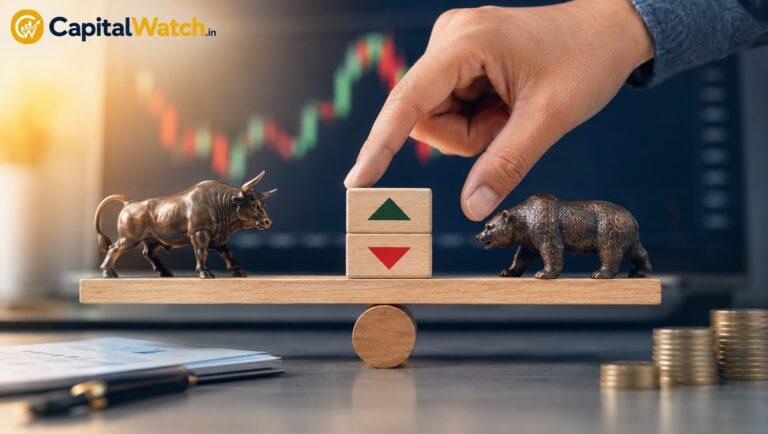
Buying a good stock is only half the job. Knowing when to sell it can be even more important.
Over the years, I’ve realized that selling shouldn’t necessarily be about whether a stock has gone up or down. A falling share price, by itself, isn’t always a reason to sell. Likewise, a rising stock price isn’t always a reason to hold.
For me, the real question is: “Is the original investment thesis still intact, and is this still the best place for my capital?”
Here are the situations that make me seriously consider selling a stock.
When Rivals Start Taking Away Market Share
A strong company can tolerate competition, but consistently losing market share is a warning sign.
If competitors are growing faster, offering better products, or taking customers away, it could indicate that the company’s competitive advantage is weakening. For example, a company that once dominated its industry may gradually lose customers to a more innovative or cost-efficient competitor.
One bad quarter isn’t enough to make me sell. But if market-share losses become a sustained trend, I need to reassess whether the company’s growth story is still intact.
When Debt Keeps Rising Without a Clear Plan
Debt isn’t necessarily bad. In fact, borrowing can be useful when a company has a clear and sensible plan to deploy that capital and generate attractive returns.
The problem begins when debt keeps increasing without a corresponding improvement in the business.
If management continues borrowing simply to fund operations, acquisitions, or expansion without demonstrating how those investments will create value, the risk increases significantly. A company that looked financially comfortable a few years ago can become vulnerable surprisingly quickly when interest costs start eating into profits and cash flows.
When Cash Flows Decline While Profits Look Good
This is one of the things I pay particularly close attention to.
A company can report impressive accounting profits while generating weak or declining cash flows. When that happens consistently, I want to understand why.
Profits ultimately need to translate into cash. If receivables keep piling up, inventory keeps increasing, or working capital requirements keep consuming cash, the reported earnings may not be as strong as they initially appear.
In simple terms: profit is important, but cash is harder to fake.
When Management Doesn’t Walk the Talk
I place considerable importance on management quality.
Management can make ambitious promises about growth, capital allocation, debt reduction, expansion, or shareholder returns. But ultimately, what matters is whether those promises translate into action.
If management repeatedly says one thing and does another, my confidence in the business naturally falls.
For example, if management talks about disciplined capital allocation but keeps making questionable acquisitions, or promises to reduce debt but continues increasing leverage, that’s a credibility problem.
A good business with poor capital allocation can still produce disappointing shareholder returns.
When the Stock Price Gets Way Ahead of Fundamentals
A great company isn’t automatically a great investment at any price.
Sometimes the business continues to perform well, but the stock price rises so far ahead of earnings, cash flows and reasonable growth expectations that future returns become unattractive.
At that point, selling may make sense even though the company itself hasn’t deteriorated.
The question isn’t simply “Is this a good company?” It is also “At this valuation, can I reasonably expect attractive returns from here?”
When the Company Ignores New Technology
Technology can completely reshape industries.
Companies that fail to adapt can find themselves losing their competitive advantage faster than expected. What looks like a small technological development today can become a major threat tomorrow.
This doesn’t mean every company needs to chase every new technology. But management needs to understand how technology is changing its industry and respond appropriately.
If a company’s business model is being disrupted and management appears unwilling or unable to adapt, that’s a serious warning sign.
When Margins Keep Falling Year After Year
Margins tell us something about the economics of a business.
If operating margins or net margins keep declining year after year, I want to know what is causing the deterioration.
Is competition increasing? Are input costs rising? Has pricing power weakened? Is the company entering lower-margin businesses? Or is management sacrificing profitability simply to maintain growth?
A temporary decline may not mean much. But persistent margin compression can indicate that the company’s competitive advantage is weakening.
When Auditors or Senior Leaders Resign Without a Convincing Explanation
Unexpected resignations by auditors, CFOs, CEOs or other key executives deserve attention.
There can be perfectly legitimate reasons for someone to leave. People retire, change careers, move to another opportunity, or simply decide to step away.
But when important departures happen suddenly and the explanation doesn’t adequately address investors’ concerns, I become cautious.
It doesn’t automatically mean something is wrong. It simply means that the situation deserves deeper investigation before continuing to hold the stock.
When My Original Investment Thesis Is No Longer Valid
This, for me, is perhaps the most important fundamental reason to sell.
Before buying a stock, I usually have a thesis — a reason why I believe the company can create value and deliver attractive returns.
Maybe I believe earnings can compound at a certain rate. Maybe the company has a strong competitive advantage, an attractive industry opportunity, excellent management, or significant growth potential.
But businesses change.
If the developments taking place in the company invalidate the reason I bought the stock in the first place, I shouldn’t continue holding it simply because I don’t want to admit that my original thesis was wrong.
Being wrong about a stock is not the problem. Staying invested after the reason for owning it has disappeared is.
And Most Importantly: When I Have a Better Story to Buy
This is probably the most important point on my list.
Capital is always limited.
If I have ₹10 lakh to invest, I cannot own every attractive opportunity in the market. Every rupee invested in one stock is a rupee that isn’t available for another opportunity.
So sometimes, I may sell a perfectly good company — not because I think it is going to perform badly, but because I have found a much better opportunity.
Imagine I own Company A, which I expect to compound my capital at 12–14% over the next few years. Then I discover Company B, where I believe the risk-reward is significantly better and the potential return is considerably higher.
If my conviction in Company B is much stronger, why should I keep my capital locked in Company A simply because Company A is still a good business?
This is where portfolio churning can be productive.
Of course, excessive buying and selling is counterproductive. Transaction costs, taxes, and the risk of making impulsive decisions can hurt returns. But refusing to churn the portfolio at all can also have a cost — the opportunity cost of keeping capital in a lower-returning investment when a significantly better opportunity exists.
For me, therefore, selling isn’t always about finding something wrong with the company.
Sometimes, the company is still doing everything right. It’s just that I have found something I believe can do even better.
The Bottom Line
Selling a stock shouldn’t be an emotional decision based solely on a temporary fall in price or fear of missing out.
For me, the decision comes down to three broad questions:
Has the business deteriorated?
Has the valuation become unreasonable?
Or have I found a significantly better opportunity for my limited capital?
The most important lesson I’ve learned is that buying requires a thesis, but holding requires continuously validating that thesis.
And when the thesis breaks — or when a substantially better investment opportunity comes along — I should have the discipline to move on.
After all, the goal isn’t to own a stock forever. The goal is to compound capital intelligently.