
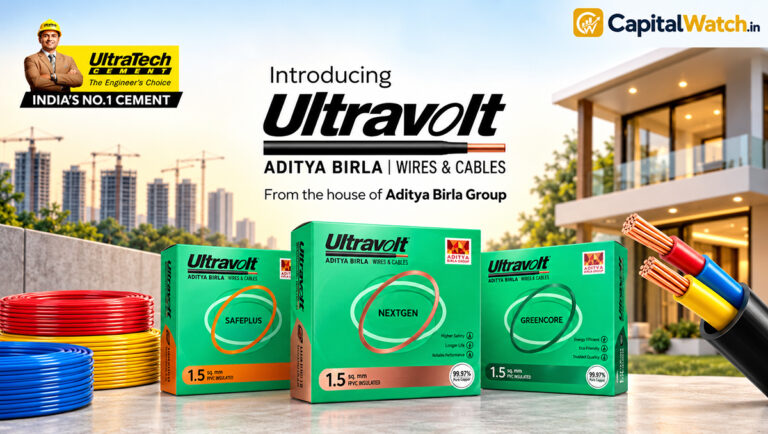
UltraTech’s entry into India’s wires and cables market has suddenly put the entire sector under the spotlight.
Polycab, KEI, RR Kabel and several other cable stocks reacted as investors assessed what the arrival of an Aditya Birla Group company could mean for competition.
But there is a problem with treating every cable company alike.
UltraTech is entering the wires and cables industry — but it isn’t competing equally with every company that manufactures a wire or cable.
From house wires to 400 kV EHV cables, winding wires and optical fibre, these are very different businesses with different customers, technologies and entry barriers.
So what exactly is UltraTech entering — and which listed companies face the real threat?
UltraTech’s ₹1,800 Crore Entry
The Aditya Birla Group has officially launched its wires and cables business under the Ultravolt brand, housed within UltraTech Cement.
UltraTech is investing around ₹1,800 crore in the business, and its manufacturing facility at Jhagadia, Bharuch in Gujarat has commenced commercial production.
The facility starts with installed capacity of approximately 10.98 lakh kilometres of wires and cables. According to the company, this already makes Ultravolt the second-largest player in India’s wires segment by installed capacity.
That’s an unusually large starting point for a new entrant.
But capacity isn’t the only reason incumbents should pay attention.
Ultravolt Is More Than a House-Wire Brand
UltraTech’s initial manufacturing focus is largely around house wires and light-duty cables, but its commercial portfolio is already broader.
Ultravolt offers home and flexible wires, power cables, control and instrumentation cables, solar cables, fire-survival cables and conduits.
The company has also indicated that it intends to expand gradually across the broader voltage spectrum and into specialised cable applications.
So while house and building wires appear to be the immediate battlefield, UltraTech’s longer-term ambitions could extend considerably further.
UltraTech’s Biggest Weapon: Distribution
This may ultimately matter more than its ₹1,800 crore investment.
The house-wire business relies heavily on a chain that looks something like:
Brand → Distributor → Retailer → Electrician/Contractor → Homeowner
For a new entrant, building this ecosystem can take years.
UltraTech doesn’t start from zero.
Its cement and building-material businesses already give it deep relationships with dealers, distributors, builders and contractors across India.
That doesn’t automatically translate into success in electrical products. But it gives Ultravolt something most new entrants don’t have: an existing route into India’s construction ecosystem.
This advantage should be particularly powerful in house and building wires, where availability, brand recognition and recommendations from retailers, electricians and contractors matter enormously.
And that tells us which companies are most exposed.
🔴 Highest Impact: Polycab India & RR Kabel
Polycab India is the most obvious competitor.
The overlap is substantial: house wires, flexible wires, LV/MV cables, control and instrumentation cables, solar cables and potentially several other categories.
But Polycab is no ordinary incumbent.
It commands roughly 30–31% of India’s organised wires and cables market, offers around 10,000 SKUs, and has a network of more than 3,900 dealers and distributors.
UltraTech therefore represents a serious new competitor — but dismantling Polycab’s distribution, brand and manufacturing advantages won’t happen overnight.
The bigger risk may initially be competitive intensity rather than market-share destruction. If Ultravolt uses aggressive pricing, dealer incentives or marketing to gain share, industry margins could come under pressure even before Polycab loses substantial volumes.
RR Kabel could be even more directly exposed to Ultravolt’s initial strategy.
Its strong presence in house and building wires, combined with power and industrial cables, creates substantial overlap. More importantly, RR Kabel operates heavily within the same branded retail electrical ecosystem that UltraTech is targeting.
For both Polycab and RR Kabel, Ultravolt is therefore a competitor worth watching closely.
🟠 High Impact, but More Diversified: KEI, Havells, Finolex & V-Marc
KEI Industries has direct exposure through house wires and LV/MV power cables, but its business extends considerably further into HT/EHV cables, institutional projects and exports.
KEI can manufacture EHV cables up to 400 kV — a technically demanding segment far removed from Ultravolt’s initial house-wire focus.
So UltraTech competes directly with part of KEI, not necessarily the entire business.
The situation is similar with Havells India.
Havells has meaningful exposure to branded consumer wires, making Ultravolt a direct competitor. But Havells also operates across switchgear, fans, lighting, appliances and Lloyd consumer durables.
Competition could therefore become intense within wires without having the same impact on consolidated Havells.
Finolex Cables has overlap through house wires, power cables and solar cables, but also operates in communication cables, optical fibre, LAN/telephone and automotive applications.
V-Marc India, meanwhile, has meaningful exposure to house wires and LT power/control cables — areas where UltraTech’s construction relationships could be particularly useful — while its HT and specialised cable businesses provide some diversification.
These companies aren’t insulated from Ultravolt, but their exposure varies significantly.
🟡 Medium Impact: Industrial & Project Cable Companies
Move away from residential electrical wires and the competitive picture starts changing.
Cords Cable Industries specialises in control, instrumentation, power, signal and specialised cables supplied to industries such as refineries, petrochemicals, metros and power plants.
Dynamic Cables also operates across LV/MV power and control cables.
Ultravolt has some product overlap here, but these markets are much more B2B and project-driven.
Technical specifications, certifications, customer approvals and execution history become increasingly important. UltraTech’s retail and construction distribution advantage consequently becomes less powerful.
The immediate competitive threat falls further as we move toward HT/EHV, transmission, railway and other specialised applications.
Companies such as Universal Cables, Diamond Power Infrastructure, Paramount Communications and Quadrant Future Tek operate in markets where technical qualification and project credentials can create significantly higher entry barriers.
UltraTech certainly has the financial resources to expand into these segments eventually.
But money alone doesn’t instantly create technical approvals or years of execution history.
🟢 Low/Negligible Direct Impact: Winding Wires & Optical Fibre
This is where the idea that “every wire company is threatened” really breaks down.
Companies such as Ram Ratna Wires, Precision Wires India and KSH International have significant exposure to winding or magnet-wire applications.
These wires go inside motors, transformers, compressors, generators and other electrical equipment.
Their customers are typically OEMs — not homeowners, electricians or building-material retailers.
The products may both be called “wires”, but their value chains are fundamentally different.
The distinction is even clearer for optical fibre companies such as Sterlite Technologies, HFCL, Vindhya Telelinks and Birla Cable.
Optical fibre transmits data using light.
Electrical cables transmit power using copper or aluminium conductors.
Same word — “cable”.
Very different businesses.
Their technology, customers, manufacturing processes and competitive landscapes are substantially different from the electrical wires market Ultravolt is initially targeting.
The Bigger Risk: What Happens to Industry Margins?
Investors shouldn’t focus only on whether UltraTech can take market share from Polycab or RR Kabel.
There is another important possibility.
UltraTech doesn’t need to become the market leader to change the economics of the industry.
A well-funded competitor can influence pricing, advertising expenditure, dealer margins, discounts, credit terms and channel incentives.
Imagine Ultravolt aggressively incentivising distributors and retailers to gain shelf space. Existing players may have to respond with higher dealer incentives or marketing expenditure to protect their positions.
Volumes could continue growing while margins come under pressure.
That’s why the most important numbers to track over the next few years aren’t simply Ultravolt’s installed capacity.
Investors should watch:
Capacity utilisation → Distribution expansion → Market share → Pricing → Dealer incentives → Advertising spend → Incumbent margins
Those indicators will tell us whether Ultravolt is merely adding capacity to a growing market — or genuinely changing the competitive structure of the industry.
Conclusion: Don’t Treat Every Cable Stock Alike
UltraTech’s entry into India’s roughly ₹1 lakh crore wires and cables opportunity is a major development.
With around ₹1,800 crore committed, substantial initial capacity, the Aditya Birla Group’s financial strength and UltraTech’s enormous presence across India’s construction ecosystem, Ultravolt deserves to be taken seriously.
But the impact won’t be uniform.
Polycab and RR Kabel appear most directly exposed, particularly in branded house wires and lower-voltage electrical products.
KEI, Havells, Finolex and V-Marc face meaningful but more selective competition, thanks to diversification into EHV, institutional, industrial or consumer-electrical categories.
Move into specialised industrial cables, winding wires and optical fibre, and the immediate threat declines substantially.
The key takeaway for investors is therefore simple:
UltraTech has entered the wires and cables market. It hasn’t entered every wires and cables business.
And understanding that difference is far more useful than selling every stock with the word “wire” or “cable” attached to it.
Disclaimer: This article is for educational and informational purposes only and does not constitute investment advice or a recommendation to buy, sell or hold any security. Investors should conduct their own research or consult a qualified financial adviser before making investment decisions.