
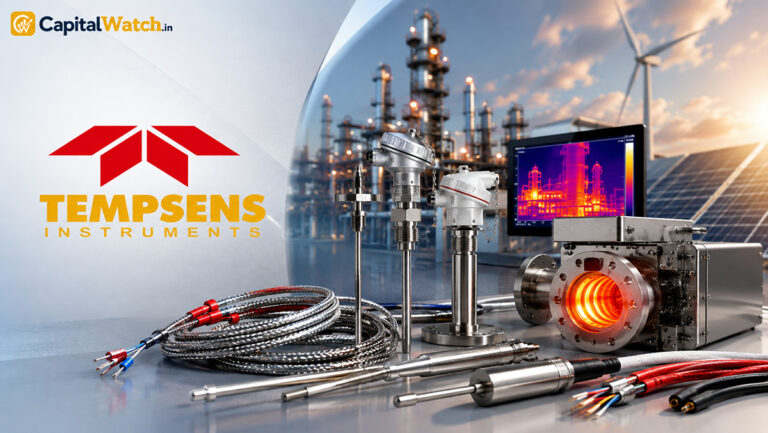
Tempsens Instruments operates in a part of the industrial economy that rarely attracts much attention from retail investors. Its products may represent only a tiny fraction of the cost of a steel plant, cement factory, petrochemical facility or aerospace project, but some of them perform critical functions where accuracy, reliability and safety matter far more than their individual cost.
That makes the Tempsens Instruments IPO an interesting proposition.
The company is looking to raise around ₹650 crore through its public issue, implying a market capitalisation of approximately ₹2,515 crore. It operates primarily across three areas — temperature sensing, specialised cables and electrical heating solutions — while also attempting to position itself for emerging opportunities such as green hydrogen, battery storage, defence, aerospace and advanced manufacturing.
At first glance, Tempsens has several qualities investors generally like: a niche business, long-standing customer relationships, relatively low debt and exposure to industrial capex.
But a good company does not automatically make a good IPO.
The bigger question is whether investors are being offered the business at an attractive enough valuation, particularly when most of the IPO proceeds will go to existing shareholders rather than into the company.
Let’s take a closer look.
A Niche Player in Thermal Engineering
Tempsens Instruments operates in the thermal engineering industry, supplying products used for temperature measurement, electrical heating and specialised cabling across critical industrial applications.
These may appear to be relatively small components within massive industrial facilities, but their importance can be disproportionately large.
In industries such as steel, cement, petrochemicals and aerospace, precise temperature monitoring can be essential for maintaining product quality, improving process efficiency and ensuring plant safety. Failure of a seemingly inexpensive sensor or heating component can potentially disrupt a much larger industrial process.
This characteristic creates an important competitive advantage.
Industrial customers are often reluctant to frequently change suppliers for critical components once a product has been tested, approved and integrated into their operations. New suppliers may have to undergo lengthy qualification procedures before being accepted.
For Tempsens, customer approvals can reportedly take up to two years in certain applications.
Once approved, however, the relationship can become relatively sticky. The company’s top 30 customers have been associated with it for an average of around eight to ten years.
That can create recurring opportunities not only from new industrial projects but also from replacement demand as sensors, heaters and other components need to be replaced over the life of a plant.
Temperature Sensing Remains the Core Business
Temperature sensing equipment is Tempsens’ largest business, contributing roughly 45% of revenue.
The company has an estimated market share of around 10% in this segment.
Its portfolio includes temperature measurement solutions used across industries including steel, cement, petrochemicals and aeronautics. It also participates in non-contact temperature sensing, where temperatures can be measured without the sensor physically touching the object being monitored.
Such technologies can be particularly useful in extremely hot, hazardous or difficult-to-access industrial environments.
The specialised nature of these products provides some entry barriers because customers often require extensive testing and qualification before approving a supplier.
However, investors should not mistake this for a competition-free market.
Tempsens competes with several domestic, smaller and international manufacturers. Moreover, demand for many of these products is ultimately linked to industrial capital expenditure.
When companies build new factories, expand production capacity or modernise existing facilities, demand can increase. But industrial capex is inherently cyclical and may slow during periods of economic uncertainty.
Therefore, while customer stickiness can provide some stability, the underlying industry may still experience periods of uneven growth.
Specialised Cables Are Emerging as an Important Growth Engine
The specialised cable business has quietly become a significant contributor to Tempsens’ overall operations.
The segment generated ₹153.1 crore in FY26, accounting for approximately 34.4% of total revenue, making it the company’s second-largest business.
More importantly, this segment has demonstrated healthy growth.
Revenue increased from ₹96.9 crore in FY24 to ₹153.1 crore in FY26, representing a CAGR of approximately 25.7%.
Unlike some of the growth visible in the electrical heating division, the expansion in specialised cables has largely been organic.
These are not ordinary electrical cables.
Tempsens supplies cables designed for specialised industrial environments where products may have to withstand extreme temperatures, demanding operating conditions and specific technical requirements.
In such applications, customers generally prioritise reliability, durability and customisation over simply choosing the cheapest supplier.
That gives specialised manufacturers an opportunity to differentiate themselves through engineering capability and product quality rather than competing entirely on price.
If India’s industrial manufacturing and infrastructure capex cycle remains supportive, this segment could continue to be an important growth driver for Tempsens.
Electrical Heating: Rapid Growth, But There Is an Acquisition Effect
Electrical heating is the company’s third major business.
The segment generated approximately ₹91.3 crore in FY26, contributing around 20.5% of revenue.
At first glance, its growth looks spectacular.
Revenue increased from just ₹10.6 crore in FY24 to ₹91.3 crore in FY26.
However, investors need to look beyond the headline growth rate.
A significant portion of this expansion resulted from the amalgamation of Marathon Heater, which became effective from April 1, 2024. Therefore, the increase should not be interpreted as entirely organic growth from the existing business.
Nevertheless, the segment offers interesting opportunities.
Tempsens is expanding its industrial heating portfolio and developing medium-voltage heaters, potentially allowing it to address a larger market.
Demand for sophisticated industrial heating systems could also benefit from continued industrial capex, energy-efficiency initiatives and increasing requirements for specialised thermal-management solutions.
The segment therefore has potential, but investors should distinguish between growth generated internally and growth created through acquisition when evaluating its historical performance.
Betting on New-Age Industrial Opportunities
One of the more interesting aspects of the Tempsens story is management’s attempt to move beyond traditional industrial applications.
The company is exploring opportunities across areas such as battery storage, decarbonisation, fuel cells, green hydrogen, defence, aerospace, nuclear energy, thermal storage and advanced manufacturing.
Many of these industries require sophisticated temperature measurement and thermal-control systems.
For example, battery systems require careful temperature monitoring to maintain performance and safety. Hydrogen and fuel-cell applications involve demanding thermal conditions, while aerospace and defence applications generally require highly reliable components capable of functioning under extreme environments.
Tempsens also appears to be investing in its technical capabilities.
The company has 83 employees working in R&D, along with 12 Indian patents and 39 international trademark registrations. Its products have a presence across approximately 80 countries.
It is also expanding its capabilities in areas such as non-contact temperature sensing, thermal imaging and fibre-optic temperature sensing.
These initiatives could increase the company’s addressable market over time.
But investors should remember that emerging opportunities are different from established revenue streams. The long-term potential may be substantial, but execution and commercialisation will ultimately determine how much of that opportunity translates into earnings.
The Micro-Epsilon Relationship Could Be Strategically Important
Another interesting development is the company’s relationship with Micro-Epsilon.
In June 2025, Micro-Epsilon acquired 49.99% of Pyrosens, creating the possibility of closer technological and commercial cooperation.
For Tempsens, the relationship could potentially provide access to advanced technologies, international customers and the broader global market for non-contact temperature sensors.
This is particularly relevant because industrial sensing is increasingly moving towards more sophisticated monitoring systems as factories become automated and data-driven.
Companies are no longer simply measuring temperature. Increasingly, industrial customers want real-time monitoring, predictive maintenance and integrated thermal-management systems.
If Tempsens can successfully move further up this technology curve, its competitive positioning could strengthen.
Balance Sheet Is Comfortable
From a financial-risk perspective, Tempsens enters the IPO with a relatively comfortable balance sheet.
Its FY26 debt-to-equity ratio stood at approximately 0.15x, while interest coverage was around 19x.
Those numbers suggest that leverage is not currently a major concern.
Ordinarily, a fresh IPO raising hundreds of crores could provide substantial capital for manufacturing expansion, acquisitions, R&D or new facilities.
But that is where the structure of the Tempsens IPO becomes less exciting.
₹650 Crore IPO — But Only ₹95 Crore Goes to the Company
The total IPO size is approximately ₹650 crore.
However, only around ₹95 crore represents fresh issuance of shares.
The remaining ₹555 crore — roughly 85% of the entire IPO — is an Offer for Sale (OFS) by existing shareholders.
In an OFS, the money paid by IPO investors goes to the shareholders selling their shares rather than to the company.
That distinction matters.
Of the ₹95 crore fresh issue, approximately ₹55 crore is proposed to be used for debt repayment, while around ₹18.1 crore is earmarked for capital expenditure in the electrical heating and specialised cable businesses.
Debt repayment will strengthen the balance sheet further, but Tempsens already has relatively low leverage.
At its current borrowing levels, the resulting annual interest savings are estimated at only around ₹5 crore.
Therefore, the debt repayment is unlikely to fundamentally transform the company’s earnings profile.
More importantly, only around ₹18 crore of IPO proceeds is being directly earmarked for growth capex.
This means the IPO should be viewed predominantly as a liquidity event for existing shareholders rather than a major growth-capital raise for the business.
An OFS by itself is not necessarily a negative. Promoters and early investors are entitled to monetise part of their holdings.
But when evaluating an IPO, investors should always ask a simple question:
Where is my money actually going?
In the case of Tempsens, most of it is going to selling shareholders.
Valuation Is Where the Investment Case Becomes Difficult
Tempsens has several attractive business characteristics.
The problem is that the IPO price appears to recognise many of them already.
At the proposed valuation, the company is being offered at approximately 35 times FY26 earnings, with an implied market capitalisation of around ₹2,515 crore.
A 35x earnings multiple is not necessarily unreasonable for a high-quality niche manufacturing company capable of delivering sustained high growth.
But it leaves considerably less room for disappointment.
Investors must therefore judge whether Tempsens can grow earnings fast enough over the next several years to justify that multiple.
There are also a few factors that deserve attention when assessing the premium valuation, including the company’s relatively modest scale, closely held promoter structure and history of related-party transactions.
Another point worth watching is the company’s visible investment pipeline.
Capital work-in-progress (CWIP) stood at only around ₹0.61 crore, which does not indicate a particularly large ongoing expansion programme.
This becomes more relevant when viewed alongside the IPO structure.
Promoter Cash-Out Versus Growth Investment
Consider the numbers together.
Existing shareholders are selling approximately ₹555 crore worth of shares through the OFS.
Meanwhile, only around ₹18 crore from the IPO is earmarked for growth-oriented capital expenditure.
For perspective, FY26 net worth was around ₹390 crore, while adjusted fixed assets were approximately ₹141 crore after excluding goodwill and intangible assets.
The size of the promoter/shareholder monetisation is therefore significant relative to the existing balance sheet of the company.
Again, promoter selling should not automatically be treated as a red flag. There can be perfectly legitimate reasons for shareholders to partially exit after building a business over many years.
But the combination of a large OFS, relatively small fresh issue and premium valuation reduces the margin of safety available to new investors.
What Works in Favour of Tempsens?
There is plenty to like about the underlying business.
Tempsens operates in specialised industrial niches where technical qualification requirements can create meaningful entry barriers. Long customer relationships provide some visibility, while recurring replacement demand can complement growth from new industrial projects.
The specialised cable business has demonstrated healthy organic growth, while electrical heating could provide another avenue for expansion.
Its R&D capabilities, international presence and efforts to enter areas such as green hydrogen, batteries, defence, aerospace and advanced temperature-sensing technologies could also create long-term opportunities.
And importantly, the company does not enter the IPO burdened by excessive debt.
These are genuine strengths.
What Should Investors Be Cautious About?
The concern is primarily about price versus opportunity.
At around 35x FY26 earnings, investors are being asked to pay a fairly demanding valuation for a relatively small industrial company whose demand remains partly dependent on the capex cycle.
Meanwhile, around 85% of the IPO consists of an OFS.
The fresh capital being deployed directly towards growth capex is comparatively small, while the company’s current CWIP also does not suggest a major near-term capacity expansion.
Investors therefore need to believe that Tempsens can generate substantial growth through its existing assets, new products, exports and emerging technology opportunities.
If that growth materialises, the valuation could eventually be justified.
If growth disappoints, however, the premium valuation leaves less room for error.
Conclusion: Good Business, But Price Matters
Tempsens Instruments is an interesting niche industrial company with several characteristics that long-term investors generally appreciate — specialised products, customer stickiness, technical know-how, low leverage, growing specialised cables and exposure to emerging industrial technologies.
The business deserves attention.
The IPO valuation deserves more caution.
At approximately 35x FY26 earnings, investors are not entering at an obviously cheap valuation. At the same time, about ₹555 crore of the ₹650 crore issue is an OFS, while only a relatively small portion of the fresh proceeds will directly fund expansion.
That changes the risk-reward equation.
The key question is therefore not simply whether Tempsens Instruments is a good company.
It is whether ₹2,515 crore is a good price to pay for the company’s current earnings and future growth potential.
For investors looking for a substantial margin of safety, the combination of premium valuation, limited growth-capex deployment and significant shareholder selling warrants caution.
Tempsens may indeed have a promising long-term industrial story. But as every IPO investor eventually learns, a promising business bought at the wrong valuation can still turn into an ordinary investment.