
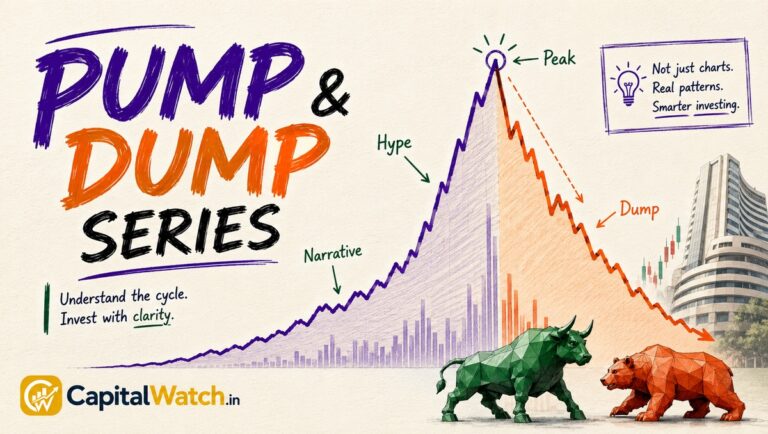
IPO price: ₹164. Record high: ₹597. Current price: around ₹166.
Few stock-market journeys illustrate the difference between a good business and a good stock price as dramatically as Zaggle Prepaid Ocean Services.
The journey can almost be summed up in three numbers:
₹164 → ₹597 → ₹166
Zaggle went from its IPO price of ₹164 to a record high of around ₹597 in roughly 15 months. Then, over the following 20 months, the stock surrendered almost the entire move.
An investor who bought at the IPO is now roughly back where the journey began. But someone who entered near the peak has seen the value of the investment fall by more than 72%.
What makes this story particularly interesting is that Zaggle’s underlying business did not collapse. In fact, revenues and profits continued to grow substantially.
So what went wrong?
The answer offers an important lesson about growth, expectations and, above all, valuation.
The Story That Excited the Market
When Zaggle listed in September 2023, it came to the market with almost everything investors like to hear in a new-age financial technology story.
The company operated at the intersection of fintech, SaaS, corporate expense management, payments, cards and banking partnerships. As businesses increasingly digitised employee expenses, rewards, reimbursements and corporate payments, Zaggle appeared well positioned to benefit from a potentially large structural opportunity.
More importantly, this wasn’t merely a good narrative. The company’s financial numbers initially backed up the optimism.
Revenue increased from approximately ₹553 crore in FY23 to ₹776 crore in FY24, before jumping to around ₹1,303 crore in FY25.
Profit growth was even more impressive.
Profit rose from roughly ₹23 crore in FY23 to ₹44 crore in FY24 and ₹87 crore in FY25.
In other words, within two years, revenue had more than doubled while profit had nearly quadrupled.
It was exactly the combination the market loves: an exciting story accompanied by rapidly improving financial performance.
When the Stock Started Growing Faster Than the Business
The market quickly recognised Zaggle’s growth potential.
From its IPO price of ₹164, the stock climbed relentlessly and eventually touched approximately ₹597 by December 2024.
That represented a gain of around 264% in just 15 months.
A ₹1 lakh investment at the IPO price would, at least on paper, have been worth more than ₹3.6 lakh near the peak.
But this is where the distinction between business performance and stock performance becomes crucial.
Zaggle’s business was certainly growing rapidly. But its share price was growing even faster.
As a stock rises, investors aren’t simply paying for what a company earns today. They increasingly begin paying for what they believe the company will earn several years into the future.
And the higher the valuation goes, the greater those expectations become.
Eventually, even good growth may no longer be enough.
₹597 Becomes ₹500… Then ₹450… ₹350… and Below ₹200
December 2024 marked a dramatic change in direction.
The stock’s record high of around ₹597 gradually became ₹500. Then ₹450. Then ₹350.
There were sharp recoveries along the way, giving investors repeated hope that the correction might be over. But those recoveries failed to restore the previous trend.
Eventually, Zaggle fell below ₹200.
Almost 20 months after reaching its peak, the stock found itself trading at around ₹166 — remarkably close to its original IPO price of ₹164.
The round trip is striking.
An investor looking only at the company’s revenue and profit growth since the IPO might find such a dramatic share-price decline difficult to understand.
But the change in ownership during this period provides another interesting part of the story.
Institutions Reduced Their Holdings While Public Ownership Increased
Zaggle’s shareholding pattern during the decline deserves attention.
In December 2024, foreign institutional investors (FIIs) held approximately 9.17% of the company. By June 2026, their holding had fallen to around 2.31%.
Domestic institutional investors (DIIs) also substantially reduced their exposure. Their holding declined from approximately 14.56% to 5.44% over the same period.
At the same time, public ownership moved in the opposite direction.
Public shareholding increased from around 36.17% in December 2024 to 47.96% by June 2026.
The number of shareholders also increased from approximately 91,000 to 1.18 lakh.
That creates an interesting picture: as the stock continued falling, institutional ownership declined considerably while public ownership expanded.
However, it is important not to interpret this automatically as promoter selling.
Promoter ownership actually moved higher, from around 40% in December 2024 to more than 44% by June 2026.
Shareholding patterns alone don’t tell us why individual investors bought or sold. But the shift is certainly worth observing alongside the stock’s dramatic decline.
The Strange Part: The Business Kept Growing
This is where Zaggle becomes a much more useful investing case study.
If revenue had collapsed, profits had disappeared and the company’s business model had broken down, explaining a 70%-plus decline from the peak would have been relatively straightforward.
But that isn’t what happened.
Zaggle reported revenue of approximately ₹1,303 crore in FY25. By FY26, revenue had increased further to roughly ₹1,853 crore.
Profit increased from approximately ₹87 crore to ₹133 crore.
So the company became significantly larger and more profitable.
Yet during roughly the same broad period, its stock price collapsed from nearly ₹600 to below ₹170.
How can both things happen simultaneously?
Because earnings growth and stock returns are not the same thing.
A company can grow its earnings substantially and still produce poor stock returns if investors originally paid a valuation that already assumed several years of exceptional growth.
The business can keep moving forward while the valuation multiple moves sharply backwards.
And sometimes, multiple contraction can overwhelm earnings growth completely.
Q1 FY27 Introduced Another Concern
More recently, Q1 FY27 showed some pressure beneath the headline revenue growth.
Sales continued to grow at approximately 18% year-on-year, suggesting that the business was still expanding.
Profit, however, fell by around 33% year-on-year.
Operating margins slipped towards 7% from around 9%, while quarterly profit after tax declined to approximately ₹17.5 crore from around ₹26 crore.
For a company whose valuation story was built partly around expectations of rapid and profitable growth, weakening profitability naturally deserves attention.
Revenue growth is important, but investors eventually need to ask how efficiently that revenue translates into operating profit, cash flow and shareholder returns.
Cash Flow and Return Ratios Need Watching
There are a few other numbers that deserve attention.
Zaggle’s return on capital employed (ROCE) has declined from approximately 33% in FY23 to around 13%.
Meanwhile, FY26 operating cash flow was approximately negative ₹6 crore, while free cash flow was roughly negative ₹113 crore.
These numbers don’t automatically mean the business is in trouble. Fast-growing businesses can experience periods in which working-capital requirements, investment and expansion cause accounting profits and cash generation to diverge.
But investors should pay attention to that divergence.
Over longer periods, profits need to translate into cash.
Similarly, if a company is deploying increasing amounts of capital to generate growth, investors need to watch whether incremental returns on that capital remain attractive.
Therefore, the next phase of Zaggle’s story may depend not merely on whether revenue continues growing, but on the quality and cash-generating ability of that growth.
Zaggle Isn’t Necessarily a Failed Business
After such a dramatic fall in the share price, it can be tempting to label the entire story a failure.
That would be an oversimplification.
Zaggle’s sales grew. Its profits grew. The company became considerably larger after listing.
The more important problem appears to have been the gap between business growth and market expectations.
At one stage, investors were willing to price Zaggle as though rapid growth would continue far into the future. As enthusiasm increased, the share price ran significantly ahead of what the company had actually delivered at that point.
When expectations moderated, the valuation corrected.
And because the starting valuation had become so demanding, even continued growth in the underlying business wasn’t sufficient to protect shareholders who entered at much higher prices.
A Good Company Can Still Be a Bad Investment at the Wrong Price
This may be the most valuable takeaway from Zaggle’s journey.
Investors naturally spend enormous amounts of time trying to identify companies capable of growing revenue and profits at 20%, 30% or even faster rates.
But identifying a growing company is only half the job.
The second question is:
What price are you paying for that growth?
Imagine that the market already values a company on the assumption that earnings will compound rapidly for many years.
What happens if the company continues growing — but slightly slower than expected?
The business hasn’t necessarily failed.
But the valuation can still fall dramatically.
That is why buying an excellent growth business at an excessively optimistic valuation can sometimes produce worse returns than buying a slower-growing business at a sensible price.
Stock returns ultimately depend not only on what happens to earnings, but also on what happens to the valuation investors are willing to assign to those earnings.
₹164 → ₹597 → ₹166: The Entire Lesson in Three Numbers
Zaggle’s stock-market journey is almost an investing lesson compressed into a single line:
₹164 → ₹597 → ₹166.
The company grew.
Revenue expanded substantially.
Profits increased.
But for a period, expectations and valuation grew much faster than the underlying business.
When those expectations eventually came down, almost the entire stock-market gain disappeared.
That doesn’t tell us where Zaggle’s share price goes from here. Nor does it mean the company cannot deliver strong growth in the future.
It simply demonstrates something investors should remember whenever they encounter the next exciting growth story.
When a stock doubles or triples on the back of a powerful narrative, don’t ask only:
“How fast can this company grow?”
Ask an equally important question:
“How much of that future growth is already included in today’s price?”
Sometimes, that second question matters far more to your eventual investment return than the first.
Disclaimer
This article is intended solely for educational and informational purposes and should not be considered investment advice or a recommendation to buy, sell or hold Zaggle Prepaid Ocean Services Ltd. Investors should conduct their own research and/or consult a qualified financial adviser before making investment decisions.
The expression “pump and dump”, where referenced in discussing Zaggle’s price journey, is used only as an informal description of the sharp rise and subsequent fall in market expectations, valuation and share price. It is not an allegation or suggestion of market manipulation, misconduct or wrongdoing by Zaggle, its promoters, management, institutional investors, shareholders or any other party.